

A full lightning protection test in 45–50 minutes per turbine
Measurable Results
Overview
CVA (Compagnia Valdostana delle Acque) is one of Italy's leading 100% renewable energy producers. Through its subsidiary Aqua EOS, it manages 81 wind turbines totalling nearly 197 MW of installed capacity across Italy.
After replacing three blades damaged by lightning strikes — each replacement costing hundreds of thousands of euros — CVA needed a way to verify that the Lightning Protection System on every turbine in its fleet was actually working, before the next strike. Tidalis delivered fleet-wide LPS continuity testing using the Voliro T robotic aerial platform, completing measurements on nearly all 81 turbines over a partnership now in its fourth year.
It was the first drone-based LPS continuity measurement campaign carried out in Italy.

Challenge
A wind turbine's Lightning Protection System is the network of conductors built into each blade that discharges a strike safely to ground at the tower base. If any part of that circuit is broken or degraded, the blade is unprotected — and the next strike can destroy it.
“We identified a serious recurring problem on our wind assets: blade damage caused by lightning strikes. In some cases we had to replace blades entirely. We're talking hundreds of thousands of euros per replacement.” - Filippo, Head of Renewable Energy Operations, CVA
Verifying the LPS conventionally means reaching every blade receptor with an aerial work platform — a 100-metre crane or lift. For CVA that route failed on two counts at once.
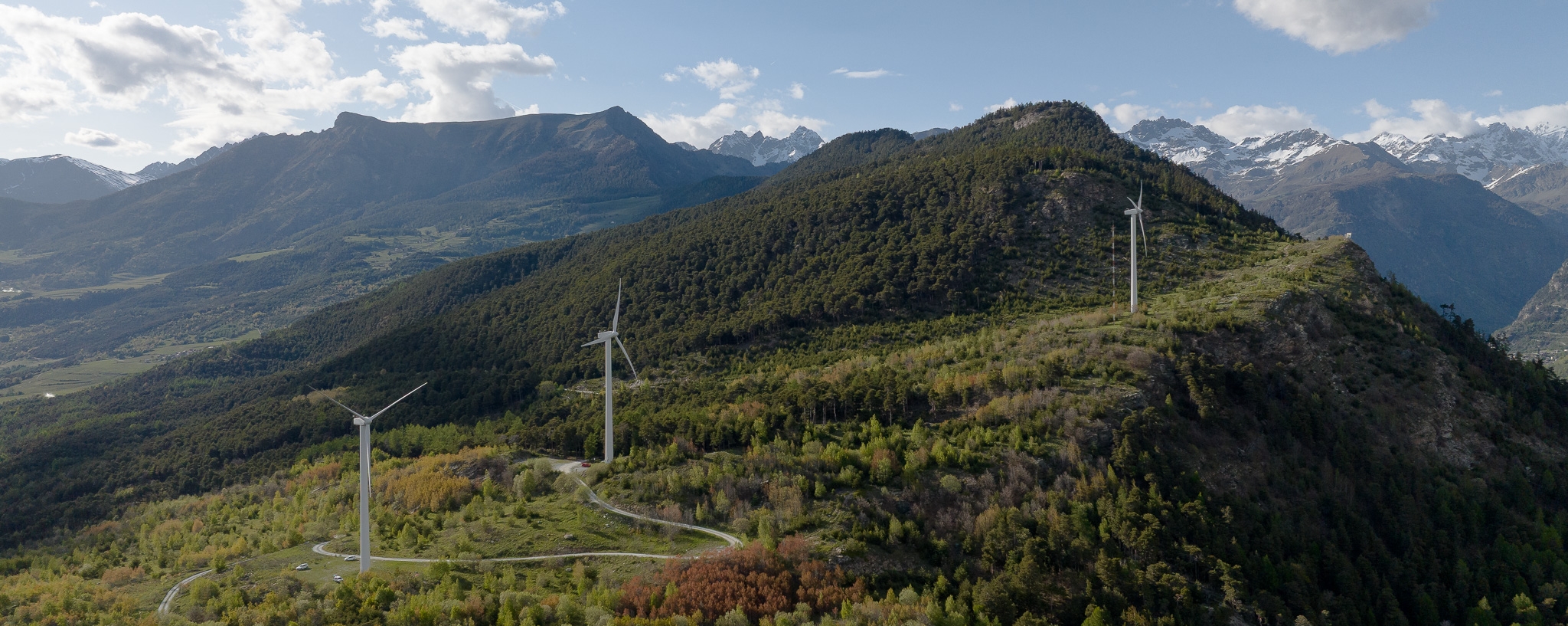
Many of CVA's wind farms sit on difficult terrain: remote sites, narrow access roads, limited space at the turbine base, and no room for the civil works a 100-metre platform requires.
Aerial platform testing was quoted at approximately €5,000 per turbine for a single measurement. Across 81 turbines, one fleet-wide inspection round would have cost over €400,000 — before counting lost production during the extended machine stops.
“When I investigated this route, the economics were simply not viable. The costs were not sustainable.” - Filippo, Head of Renewable Energy Operations, CVA
Prevention was the obviously correct strategy and the obviously unaffordable one. That was the problem to solve.
Solution
After an extensive evaluation of the drone-based inspection platforms on the market, Tidalis selected the Voliro T — an omnidirectional robotic drone able to apply controlled force against a surface in any orientation, which is what makes physical probe contact at every receptor point possible.
“We chose Voliro after testing several solutions, for its innovative approach, its unique technology in the market, and above all because it guarantees us operational flexibility and reliability in inspection execution.” - Federico Fattorini, CEO, Tidalis
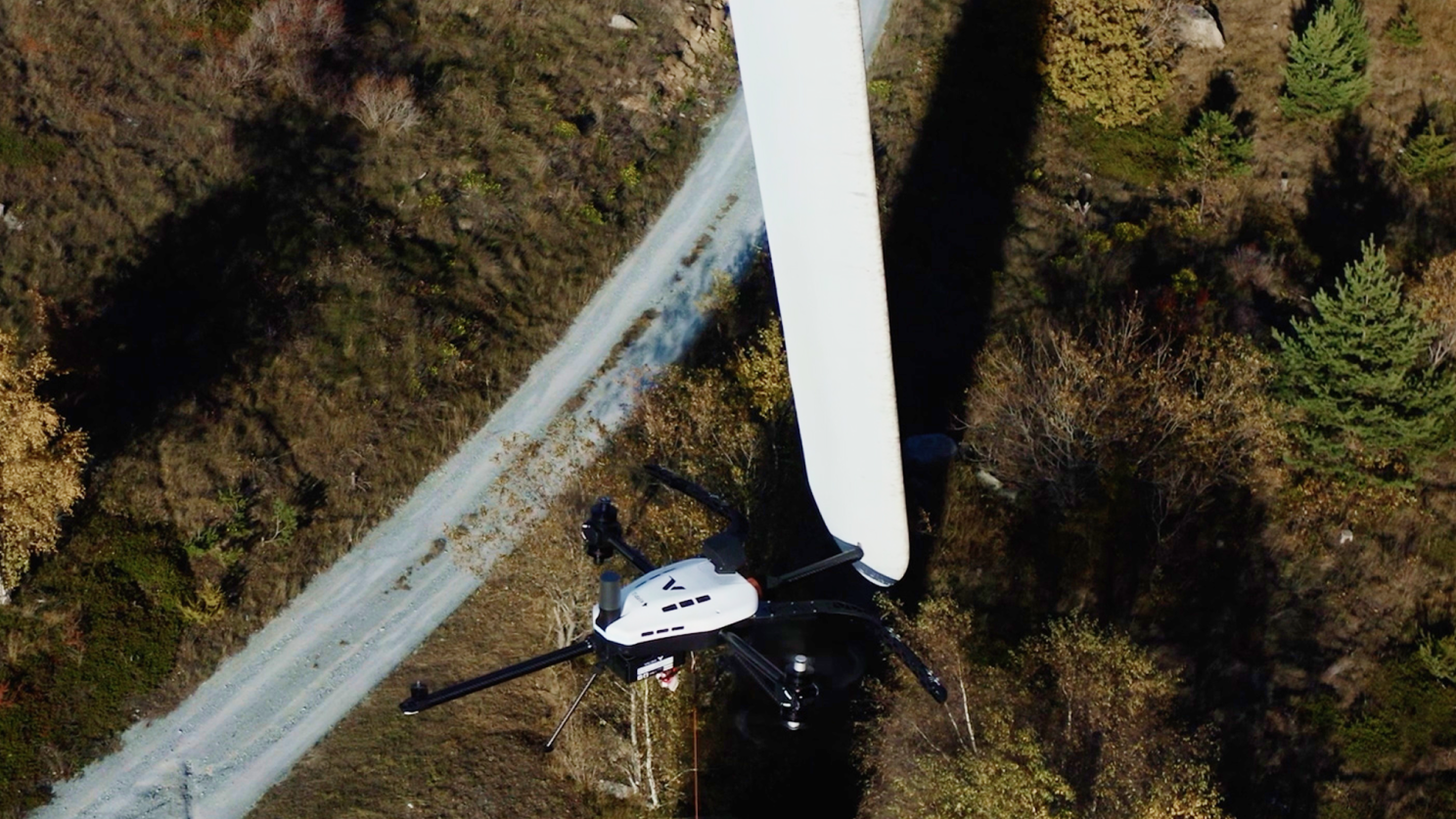
Tidalis delivers drone-based LPS continuity inspections on wind turbines using the Voliro T robotic platform.
- The Voliro T approaches the blade receptors — the small metallic discs set at the blade tip and at intervals along the blade, typically seven to nine per blade depending on rotor diameter.
- Using a specialised nose probe, the drone injects a small current into the LPS at each receptor point.
- The circuit is closed at the tower base on the exterior, allowing Tidalis operators to measure full electrical continuity from blade tip to ground.
- Continuity confirmed across all receptors verifies the LPS as functioning, with no weak point where a strike could cause damage.
All three blades of a turbine are completed in a single flight.
“Our workflow is highly streamlined thanks to the platform we use. From our arrival under the turbine to departure, it typically takes 45 minutes — 50 minutes at most.” - Flavio Angoli, Operations Manager, Tidalis
Results
Transformed economics
The drone-based method eliminates crane rental, civil works, site preparation and the logistics chain that made conventional testing unworkable. Systematic, fleet-wide LPS monitoring became economically viable for CVA for the first time.
Minimal downtime
Three blade measurements in one 45–50 minute flight, arrival to departure. Lost production during inspection drops sharply against platform-based testing, which required far longer machine stops.
“Using drones significantly reduces machine downtime, limits lost production, and almost completely eliminates ancillary costs. The drone reaches components that would otherwise be extremely difficult to access.” - Filippo, Head of Renewable Energy Operations, CVA
Prevention instead of replacement
This is the outcome that matters. Knowing the condition of every LPS in the fleet before lightning season lets CVA intervene early — repairing or replacing a degraded receptor at a fraction of the cost of a full blade replacement.
“Lightning events are increasing year on year. I believe that prevention and predictive inspection are fundamental in our line of work.” - Filippo, Head of Renewable Energy Operations, CVA
A first for the Italian market
CVA and Tidalis carried out the first drone-based LPS continuity measurement activity in Italy, on a fleet of 81 turbines, and have been working together for three to four years.
“Voliro's technology is genuinely at the forefront in Italy. CVA was a pioneer — the first operator on Italian territory to adopt drone-based LPS measurement. I think the wider sector still has significant catching up to do.” - Filippo, Head of Renewable Energy Operations, CVA
Outlook
Lightning damage to turbine blades is a growing cost across the Italian and European wind sectors, driven by the increasing frequency of extreme weather. Preventive LPS monitoring, delivered at fleet scale, is the cheapest available protection for the asset — and the only version of it that is economically viable is the one that does not need a crane.
Have a wind fleet with no LPS baseline?
Tidalis delivers Voliro T-based LPS continuity testing across Italy, from accessible lowland farms to remote mountain terrain.